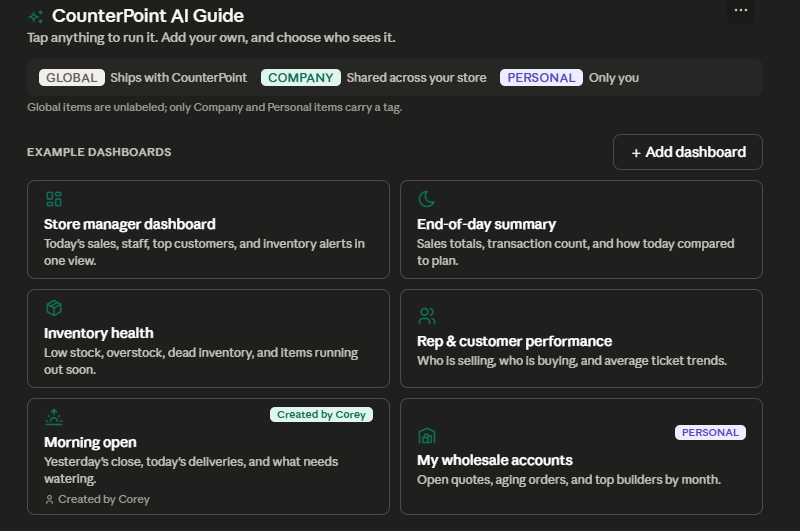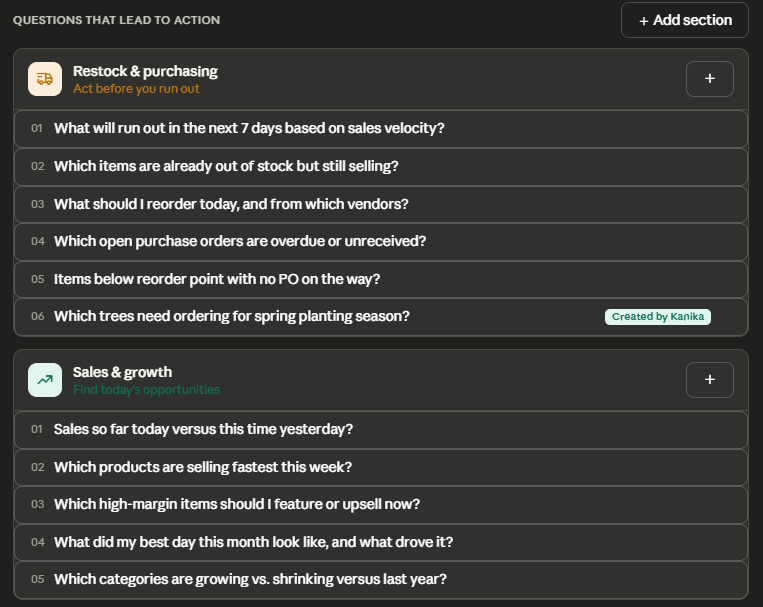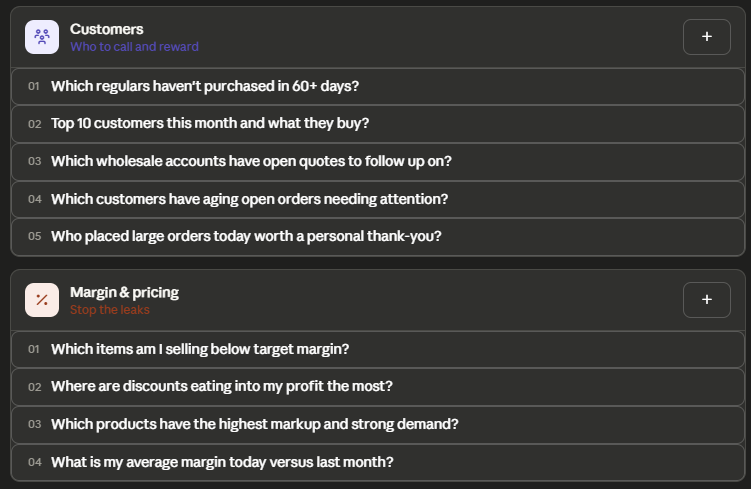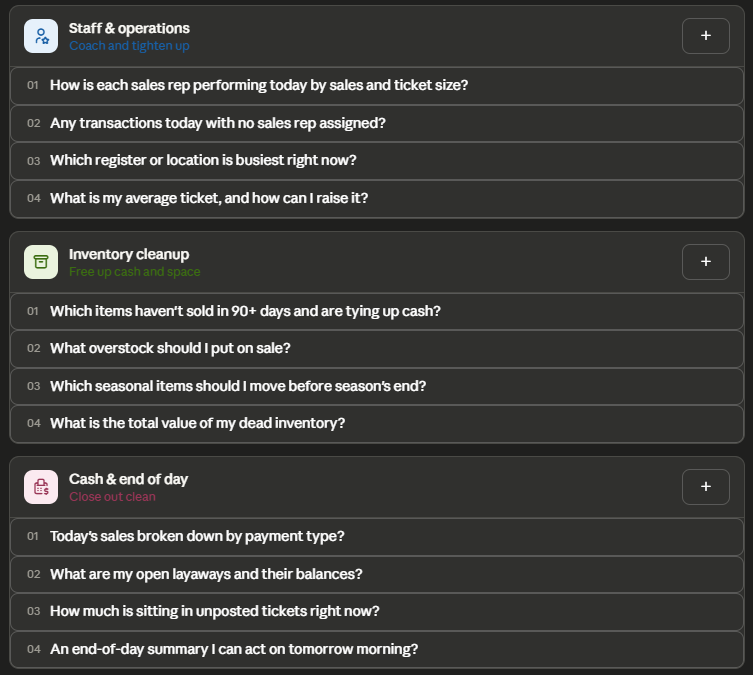
Conversational Analytics
MEET BARTON: The AI Connector built directly into your NCR Counterpoint database, so anyone on your team can ask a business question in plain English and get an answer drawn from your live numbers. No reports. No filters. No waiting on the one person who knows how to build one.
"*" indicates required fields
Owners don't sit at a desk. Barton works anywhere Claude does — the phone in your pocket, a tablet on the sales floor, a laptop at home on Sunday night.
Same data, same answers, no VPN and no remote desktop session.
Ask on the drive in. Have the answer before you park.

Billed by Rapid POS
Flat for your whole business, however many people connect.
One-Time Installation
Paid once, when we get you running.
$299
One time
Monthly AI Connector Subscription - Barton
Everything in the list below. Cancel anytime.
$99
Per month
Billed by Anthropic (Claude)
Claude plan
Per person who uses it. Free covers occasional use, Claude Pro covers most people, heavy users may want more.
$0–20
Per person / mo
Custom development is available, billed T&M.
Need help creating a custom skill to teach Claude something it isn't figuring out on its own, or want extra support creating your own custom dashboard? We scope it, quote it, and you approve the estimate before any work starts. Billed at our standard rate of $156/hour.
The $299 setup fee is non-refundable. AI subscriptions are billed separately and directly by the provider — Anthropic for Claude, OpenAI for ChatGPT. Their pricing and plan features are set by them and can change; check current plans before you buy.
Put your Counterpoint data within reach of everyone on your team — in plain English, from anywhere.
New to AI tools? Start with the first question — it's the one that clears up the most confusion.
Barton is a secure connector, that lets an AI assistant like Claude securely connect to external systems and databases in real time.
Think of it this way: Claude is extraordinarily intelligent, but out of the box it knows nothing about your business. It can’t see your sales figures, your inventory levels, or your transaction history — because that data lives in NCR Counterpoint, not on the internet.
Barton is the bridge. It gives Claude secure, structured access to your Counterpoint data so when you ask a question, Claude is reading your actual numbers — not guessing. Without it, you’d need a developer to manually export data, write custom queries, or build a full connection from scratch.
But Barton isn’t just a pipe. Counterpoint has decades of database structure behind it — which table holds on-hand quantity, how a transfer differs from a sale, how stock moves between locations, why two fields that look identical aren’t. All of that’s built into Barton, so Claude reads your numbers the way you’d read them instead of guessing at them like a stranger would. That’s the hard part, and it’s the part we’ve spent years learning.
We don’t make AI. We make it worth having if you run Counterpoint.
Claude is a general-purpose AI. It’s brilliant at reasoning and answering questions — but it has no way to access private business systems on its own. It doesn’t know your SKUs, your sales history, or your store’s inventory.
Beyond access, there’s the question of how to speak Counterpoint. NCR Counterpoint has a specific database schema, data relationships, and business logic built up over decades. Knowing which tables to query, how inventory is tracked across locations, and how transactions are structured requires deep domain expertise. That’s the work Barton does, so Claude can interpret your Counterpoint data correctly from the first question you ask.
Yes — Barton is a connector, not a standalone app. You’ll need an active subscription with an AI assistant that supports custom connectors.
We build for Claude, we test against Claude, and Claude is the only assistant we support. Every prompt, every setup instruction and every validation pass we run is against Claude, made by Anthropic — the company that created the MCP standard Barton runs on. It’s the configuration we know performs, and it’s what we recommend without hesitation.
MCP is an open standard, so Barton will technically function with any AI that supports custom MCP connectors, including ChatGPT, Perplexity and others. If that’s already your company standard, it will work — but understand what you’re choosing. We haven’t tested or tuned it there, results will vary, and we can’t troubleshoot it for you. Setup support and accuracy tuning are for Claude configurations only.
Your AI subscription is billed separately, directly by the provider.
Honest answer: very good, but not guaranteed to be perfect. Barton gives Claude direct access to your live Counterpoint data, so the raw numbers it retrieves are accurate. The risk lies in interpretation — how Claude understands your question, which time range it applies, or how it handles unusual data conditions.
Our recommendation: trust, but verify. Use the AI to surface insights quickly, then spot-check anything that will drive a purchasing decision, staffing change, or financial report against your Counterpoint data directly. Think of it as a very fast, very capable first draft — not a final authority.
Not quite, and the reason is worth a minute of your time.
Claude doesn’t have your data sitting in front of it. It works the way a good analyst works: read the question, work out what it needs, go get it, look at what came back — and go back for more if the answer isn’t there yet.
So when you ask “why has this category been slipping?”, Claude doesn’t run one lookup. It asks Barton for the category’s recent sales. Reads them. Realizes it needs last year’s numbers to tell a real decline from a seasonal one, so it asks again. Notices the drop is in one location and not the other three, so it asks again. Every one of those is a round trip to your Counterpoint database.
Simple questions are a single trip and come back in seconds. Analytical ones take several, and run longer, but get you a more comprehensive answer.
It also varies by which assistant you use. Claude leans analytical: it would rather make one more call to Barton than hand you a confident guess. That’s exactly what you want when the number is about to drive a purchase order, and it’s part of why we build for Claude.
Yes, Anthropic allows custom connectors on the free Claude plan, limited to one connector — which is all you need for Barton.
The catch is usage. Free accounts have tight limits on how much you can ask, and you’ll reach them quickly once you start putting real questions to real data. It’s fine for occasional, casual use.
There’s no specific model to choose. Connectors work at the account level, not the model level — so whichever current Claude model you’re working in will be able to use Barton. You don’t need to hunt for the right one.
What matters is the plan. Anthropic supports custom connectors on Free, Pro, Max, Team and Enterprise plans. For most retailers an individual paid plan (Claude Pro, currently $20/month) is the practical starting point. If several people will use it, a Team plan is worth considering — on Team and Enterprise an account Owner adds the connector once and everyone else simply connects to it, which is far easier to administer than setting it up person by person.
Plans and prices are set by Anthropic and do change. Check their current pricing page before you commit, and we’re happy to talk through which plan fits how your team works.
Your data never leaves your environment without you asking for it. Barton operates on a request-only basis — when you ask a question, it fetches only the data needed to answer it. Nothing is stored on our servers, and nothing is sent to Claude proactively.
Claude is governed by Anthropic’s privacy policies, available at anthropic.com. We recommend reviewing both before enterprise deployment.
No. Out of the box, Barton has only read access. It can look up and analyze information in your Counterpoint company database — running queries, calculating metrics, and building dashboards — but it cannot change anything. It has no ability to insert, update, or delete records, and it can’t modify settings, configuration, or customizations.
Yes — and that’s by design. Barton is a living product. We’re continuously expanding what data it can reach and how accurately it interprets your questions. Every improvement ships automatically to subscribers — no reinstallation, no upgrade fees. Your feedback directly shapes the roadmap.
Your $99/month keeps Barton current.
AI moves fast. Models get updated, capabilities change, and platforms shift — often weekly. Your subscription means you never have to track any of it.
What’s included:
Custom Skills
Barton allows Claude to handle most questions accurately out of the box, and we include instructions so you can build your own skill when it misses the mark. If you’d rather we build it, custom skill development isn’t covered by the $99 — we quote it at our hourly rate of $156. Many skills take as little as 30 minutes ($78).
The Key Point
We absorb the maintenance so your team keeps working with confidence — and gets new capabilities the moment they’re ready.
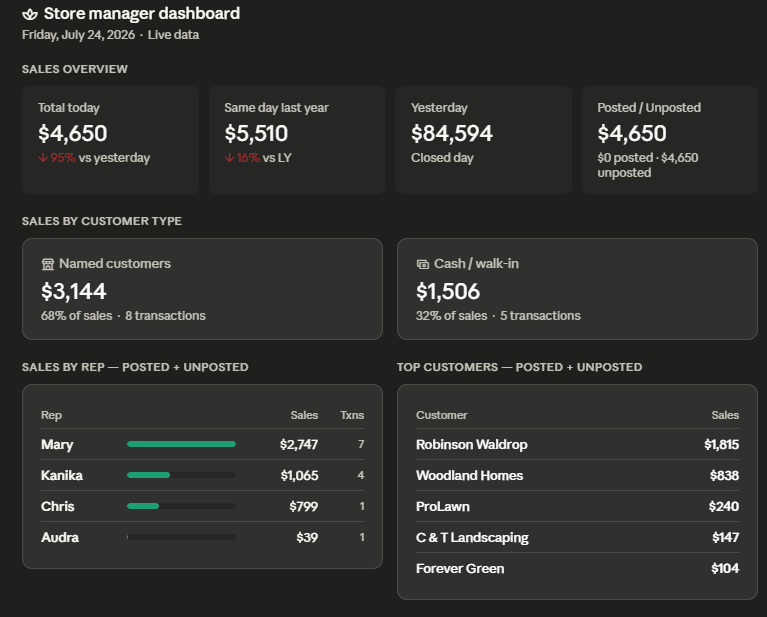
Get the full picture of your business without waiting on a report or a phone call.
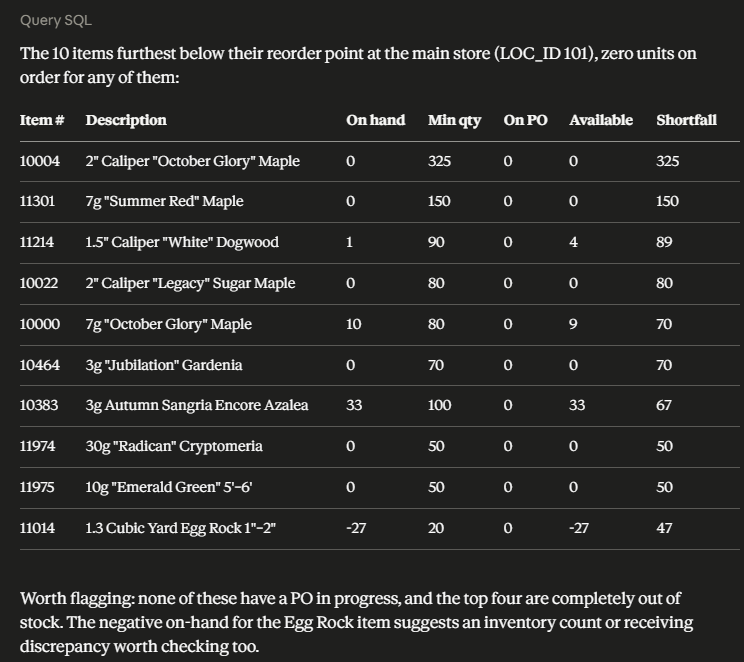
Stay ahead of stock issues and catch problems before they reach your customers.
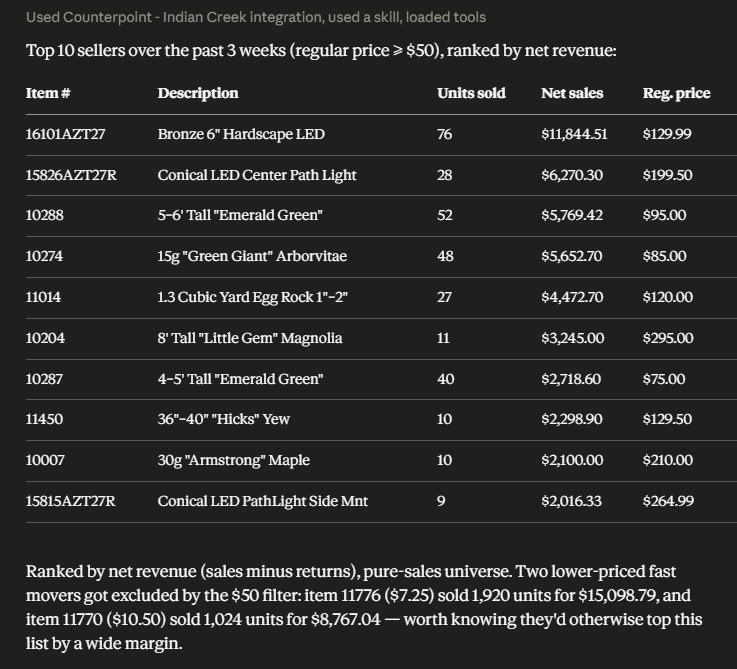
Check what actually sold, at which location, before you commit to the next order.
See across all locations in one place, without logging into each system separately.
“What's running low across all my locations?”
Instead of running a stock report, exporting it and reading between the lines.
“How did last week compare to the same week last year, by category?”
A period comparison in one sentence instead of an afternoon in spreadsheets.
“How much did XYZ, Inc. purchase last month, broken out by category?”
Customer and account history, without piecing it together screen by screen.
“Which location has the most of this on hand?”
One question covers every store — no logging in and out of each one.
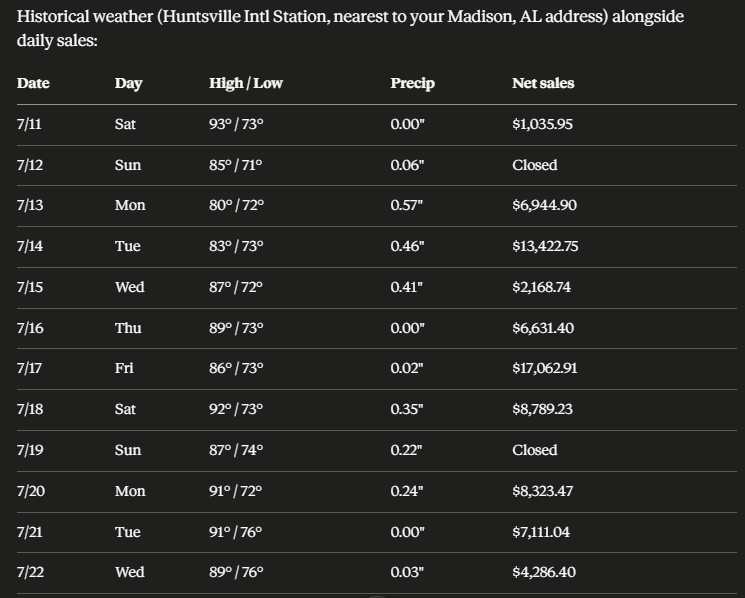
“Has this category been slipping for a few weeks?”
Patterns across days, weeks and seasons that no single report would show you.
Anyone on your team can ask in their own words. Whoever knows how to build a Counterpoint report stops being the bottleneck for everyone else.
Put your Counterpoint data within reach of everyone on your team — in plain English, from anywhere.